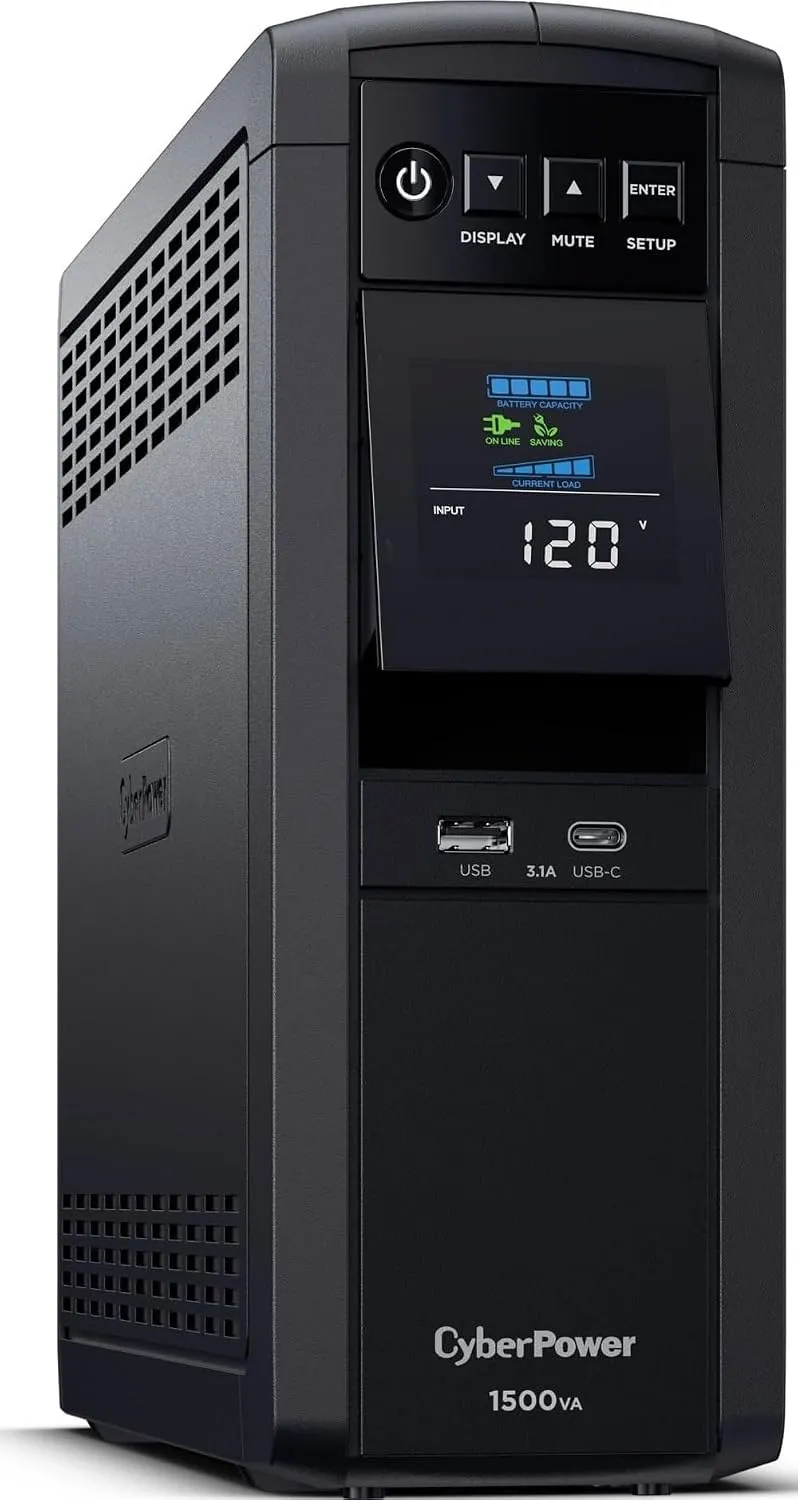
If you live anywhere with storm season, you already know the risk: a brownout, a flicker, an instant drop to nothing, and your desktop PC shuts off mid-write. For most home offices, a UPS isn’t a nice-to-have, it’s the difference between a clean shutdown and a fried motherboard. The CyberPower CP1500PFCLCD has been the workhorse we recommend for that exact job — here’s why.
Why pure sinewave matters for modern PC gear
The CP1500PFCLCD outputs a pure sinewave (PFC sinewave in CyberPower’s terminology), which is what modern power supplies with active PFC actually expect. Cheaper simulated sinewave UPS units can cause Active PFC power supplies to overheat, behave erratically, or refuse to switch to battery at all. If you’re protecting a desktop with an 80+ Gold or Platinum PSU, an OLED monitor, or anything with an Apple Silicon-class laptop charger on the battery side, pure sinewave is the safe choice.
It’s also why this is the model we point people to in our UPS buying guide and our sinewave explainer — it’s the right tool for the modern PC power chain.
What you actually get: 1500VA / 1000W, 12 outlets, AVR
CyberPower rates the CP1500PFCLCD at 1500VA / 1000W — enough to back up a typical desktop PC plus monitor for around 8 to 12 minutes at full load, and considerably longer for lighter loads like a router, modem and NAS. The 12 NEMA outlets are split half battery-backed and half surge-only, so you can plug everything in without burning through your runtime on things that don’t need it.
There’s also AVR (automatic voltage regulation) which boosts or trims the input voltage before it reaches your gear. In areas with dirty power, this means your PC sees a steady 120V instead of a slowly degrading input, and the battery only kicks in for real outages — which extends battery life considerably.
The color LCD is more useful than it sounds
The front LCD shows real-time input voltage, output voltage, estimated runtime at current load, load percentage, battery charge and event log. It’s not a marketing gimmick — it’s the difference between guessing why your PC rebooted and being able to see at a glance that you had a brownout to 88V for 12 seconds. The screen tilts so you can read it whether the UPS is on the floor or on a shelf.
Software and monitoring
CyberPower’s PowerPanel software (Windows and macOS) gives you a real shutdown agent — set the runtime threshold, and the PC will save work and shut down cleanly before the battery dies. That alone is the reason most home offices buy this unit rather than a smaller 600VA model: the difference between graceful shutdown and a hard power loss is exactly what kills SSDs and corrupts database files.
Warranty and the equipment guarantee
The CP1500PFCLCD ships with a 3-year warranty that includes the battery, which is the part that actually wears out. CyberPower also backs it with a $500,000 Connected Equipment Guarantee — if the UPS fails to protect properly connected gear, they’ll cover damage up to that cap. We don’t recommend treating that as insurance for your daily driver, but it’s a real signal of how the company stands behind this model.
Who this is for (and who it isn’t)
The CP1500PFCLCD is the right call if you’re protecting a mid-to-high-end desktop PC, a workstation, a gaming rig, a home server, or a small recording / streaming setup. If you only need to keep a modem and router alive during a short outage, a smaller 600VA unit will last longer on the same battery. If you need to back up a server room, you’re in the online double-conversion category, not this one.
The bottom line
The CyberPower CP1500PFCLCD is the rare piece of infrastructure that just works. Pure sinewave output, AVR, 12 outlets, a real LCD, useful software, and a warranty that includes the battery. For a home office or studio, it’s the one we recommend first, and the one we trust with our own gear.
Frequently Asked Questions
Yes. The CP1500PFCLCD outputs a pure (PFC) sinewave, which is what modern Active PFC power supplies expect. Cheaper simulated sinewave UPS units can cause those PSUs to overheat or refuse to switch to battery at all.